
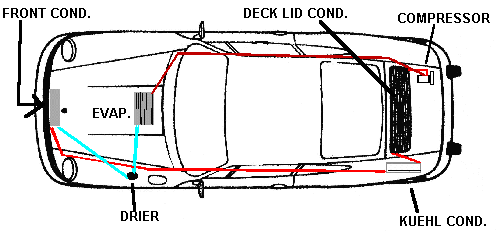
Would you believe the typical Porsche 911 we are working on has nearly 40 feet of rubber air conditioning hose! And, a 930 hase 43 feet. The air conditioning hose type or design dates back to the 1950’s. Why so much hose? Well the air conditioning compressor is in the back. The evaporator is in the front along with the drier and front condenser. And the primary condenser in the back. So, if you run back and forth you cover a lot territory. The real problem with the stock a/c hoses is that they leak refrigerant on a constant basis. Meaning for every linear foot of ac hose you have so many parts per million of refrigerant that slowly leaks out. The leak rate per linear foot is so small that refrigerant dyes will not penetrate refrigerant hose because the dye is suspended in the refrigerant oil. And, an electronic refrigerant “sniffer” will not detect the leaks because the electronic detecors are not that sensitive: if the detector was sensitive enough for a leak that small the detector would most likely be set off by other things nearby. So what you have are thousands of very small “leaks” spread out across a lengthy piece of hose… and all the small leaks add up to a large one.
With these facts in mind, if we step back to 1982, when this car rolled out of the factory fully charged with refrigerant, it was only a matter of time, usually a year or two, before you had to “top off” or add more refrigerant. Every year. Back in 1982 that was not such a big problem as R12 only cost $1.75 per pound, and we were not aware of “ozone depletion” which leads to greater amounts of harmful UV rays bombarding us.
With the new knowledge that certain types of refrigerants, such as R12, can cause the depletion of ozone in our stratospheric layer above earth’s surface, a new replacement refrigerant was developed called “R134a”. Studies were also performed by the a/c industry regarding leakage in the system and it was determined that a better refrigerant hose was needed as well. So a new standard for refrigerant hose design was drafted, outlined in SAE (Society of Automotive Engineers) specifications. We call this new hose “barrier” hose. Barrier hose has an additional liner inside the hose ( a non plasticized nylon co-polymer) that reduces the permeation (leakage) rate of refrigerants.
Studies were performed by Dupont (a producer of R134a) as well as several of the hose manufacturers. In one Dupont study sections of non-barrier (old fashion hose) and barrier hose were compared to see how much refrigerant each type of hose leaked. They call the leakage “permation”, meaning the refrigerant leaks through the wall of the hose. Sections of each type of hose, 30 inches long with a 5/8″ ID hose, were compared. They filled the hose to 80% of its maximum volume with liquid refrigerants (comparing R12 to R134a). They heated it to 176F. They don’t tell us the pressure but we might guess it was 380 psi for R134 and 333 psi for R12 depending upon your interpretation of temperature/pressure charts (typical of the high side on either an overcharged system or a very hot day, most systems don’t run that high of a psi; I’d suggest 225-250 psi is a fair average (although pressures can be much higher) while the compressor is pumping, and 100 psi is a fair average “resting” psi when the system is off. They calculated the yearly leakage rates to be: for R12 refrigerant about 1.5 pounds per year with non barrier hoses and .3 pounds per year with barrier hoses; for R134a it was 1.8 pounds per year for non barrier and .2 pounds per year with barrier hoses. Frankly there is a great loss with non barrier hoses regardless of the type refrigerant you use. And logically, the more you use your AC system the greater your losses are, there is a big difference in AC “on” time for someone up in Seattle vs. someone in Houston and likely the same is differences for a ‘weekend’ driver vs a ‘daily’ driver.
Here is where the Dupont study is important to 911 and 930 car owners. The study was forecasting ‘front engine’ cars which typically have all of their components (compressor, condenser, drier, evaporator, and all connecting hoses) located closely near each other. A 911 or 930 is a totally different animal. Components on our cars are spread out all over, hence the need for 40-43 linear feet of hose. The Dupont study forcasted leakage based for a typical car only having 6 to 10 feet of hose at most; some front engine cars have less. For a front engine car this would equal about 9.2 cubic inches in internal hose volume or 60 square inches of internal surface area. A 911 on the other hand has about 66 cubic inches of hose volume and 621 square inches of internal hose surface area. So the difference between the average front engine car vs. a 911 is:
Front engine car = 21 cubic inches, 178 square surface inches
Rear engine 911 = 66 cubic inches, 621 square surface inches.
The 911 has 214% increase in cubic volume and a 249% increase in hose surface area (the later is more important in terms of permeation).
Less permeation is critical especially with R134a refrigerant since the molecule is smaller than R12, system pressures run at bit higher and so the refrigerant could leak out of old style hoses sooner than expected. In addition, this new type of ac hose construction tends to be more forgiving when flexed; the 911 ac hose lines have a few corners here and there to bend around. So barrier hose is a nice thing!
So we stripped out all 5 of the 22 year old a/c hoses and installed a brand new Griffiths barrier hose set. The job of removing the ac hoses is straight forward and you do not need a car lift. As a matter of fact the entire Mr. Ice Project was done with a simple roll around jack and a jack stand or support. Take one a/c hose out at a time and replace it with the new barrier hose. Though replacing the ac hose set is the most time consuming part of the project, figure 8 hours for the average 911 DIY or do it yourselfer on the ground, a few hours less up on a lift, it is an absolute necessity. It does not make much sense to achieve lower vent temperatures one day only to find out the reason your vent temperatures have risen the following week was because you did not replace the original leaking a/c hoses.
Replacing the a/c hoses is not difficult. You do not have to remove the engine or the car’s interior. When we got done with the project we came up with a “how to” instruction set that walks you logicially through the procedure. Here is a brief summary: There are three a/c hoses in the engine compartment: compressor to evaporator and the rear condenser to front condenser. Two of the hoses exit down in slots adjacent to the rear shock towers and come out near the heater boxes underneath, traveling further under the tub to their component destinations. The compressor to rear deck lid condenser hose is one of the easiest to replace by the way. There are two hoses which are accessed behind the driver’s side front tire, the drier to front condenser and the drier to evaporator, and the rear condenser to front condenser passes by here too. All the a/c hoses are held to the body with a clamp and screw. We simply removed them, dropped the hose, temporarily put them back in place so we could find the mounting points easily, and re-attached these orginal clamps while installing the new barrier hose set. Almost all the hose fittings (ends of the hose) have a nut on them of which are in inch increments, for example, 3/4″, 7/8″, so you can use standard non metric wrenches.
On this installation, with the Kuehl Fender Condenser we designed, we used 6 refrigerant hoses compared to the original 5 hoses the car came with. In reality we will have a little more total length of hose as compared to the original hose set, however we end up with less hose weight and less hose volume because of the size of the hose we are using and the type of hose. And, we will be using less refrigerant! We will talk about the “less refrigerant” idea later on.
